The problem with the deck
Every innovation program eventually faces the same wall: how do you make people care about change they didn’t ask for? The default answer is a presentation — forty slides of ambition, frameworks and arrows. The problem is that a deck asks an audience to sit still and absorb. It turns a living program into a document. By slide twenty-three, the energy is gone and so is the room. For a school whose whole point is hands-on, vocational learning, presenting innovation as a passive slideshow would have contradicted the very culture it was trying to build.
The concept
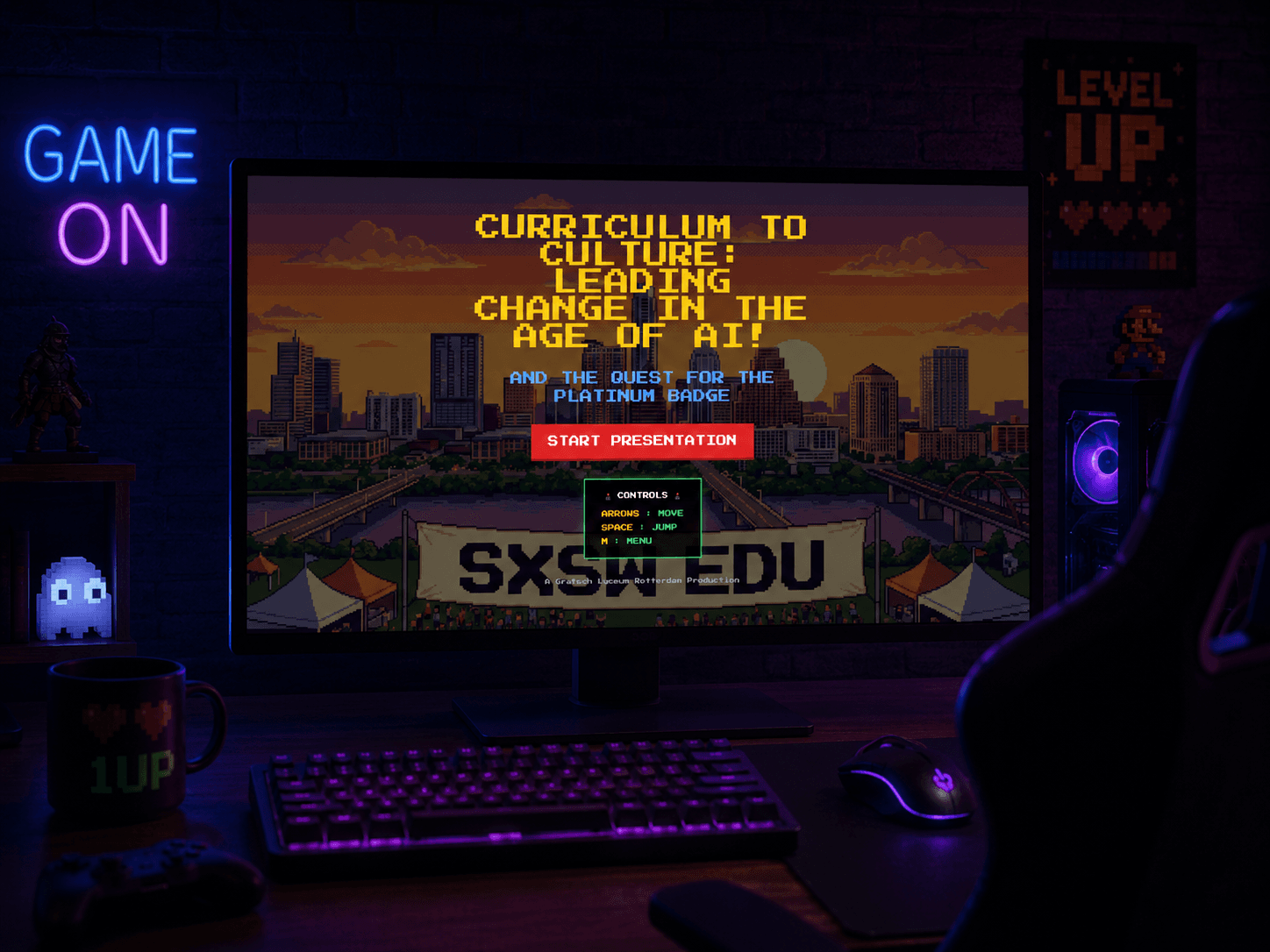
So we asked a different question: what if people could play the program instead of watch it? A retro arcade game fit the school’s culture exactly — it’s tactile, a little rebellious, and unmistakably made by people who make things. The side-scrolling format mirrored the shape of the story itself: a journey from where the program started (curriculum) to where it was heading (culture), with obstacles, allies and small wins along the way. Every level became a chapter. Every mechanic became a metaphor for the real change the school was driving. This is the part no AI could have supplied: the decision that a game was the right form, the narrative design that mapped a change program onto arcade levels, and the taste to keep it honest rather than gimmicky.
The build
Here’s the honest breakdown. AI built almost everything you can see and touch: the code, the pixel art, the level scaffolding, the iteration. What used to take a studio months — sprite work, game logic, browser deployment — happened in a fraction of the time, with dozens of fast iterations where we’d play a version, feel what was off, and rebuild. What AI did not do is the part that mattered most: the concept, the story arc, the level design as narrative, and the hundred small taste decisions that separate a real thing from a generated one. That division of labour — AI for speed, humans for meaning — is the entire method behind SUPAH/STUDIO. The game runs in any browser, with no install, so anyone can play it from a link.
The result
Instead of a presentation people endured, the school got an experience people chose to finish. Stakeholders played it. Staff shared it. The story of the innovation program stopped being something to be briefed on and became something to be experienced — and the difference showed in how people talked about it afterwards. A game gets forwarded. A deck gets archived.
What this means for you
If you have a strategy, a program or a vision that keeps dying in slide 23, the format is probably the problem — not the idea. The same method that turned a school’s innovation program into a game can turn your annual report into something explorable, your strategy into a tool people actually use, or your vision into a prototype people can touch. Human concept, AI execution, delivered in weeks.